💊 Our Heme / Onc study of the month: Drugging the “holy grail” KRAS G12C in metastatic NSCLC with CodEBreak 200 |
|
|
📘 Journal Club: Fresh Off the Press |
Bringing you the latest practice-changing updates in Hematology/Oncology
|
|
|
✅ Study of the Month: Sotorasib vs. Docetaxel for previously treated metastatic non-small cell lung cancer with KRAS G12C mutation: a randomized, open-label phase 3 trial
Study link: CodEBreak 200
Take-Home Points
- This is the first study to demonstrate the clinical efficacy of a dedicated KRAS G12C inhibitor, sotorasib, in solid tumors, namely, mNSCLC.
-
Sotorasib successfully led to delayed disease progression as well as better disease control, progression, tolerability, and patient outcomes. There was a significant signal for intracranial activity as well.
-
Unfortunately, sotorasib did not prolong overall survival compared to SOC docetaxel +/- ramucirumab or nintedanib. Despite this notable limitation, it remains an excellent option for older patients who might not otherwise tolerate cytotoxic chemotherapy.
💊 Study Importance
- Previously dubbed “the holy grail” of precision oncology, KRAS inhibition has eluded researchers for decades since its discovery.
-
The study’s predecessor, CodEBreak 100, was the first phase 2 trial to evaluate KRAS G12C-specific targeted therapy in solid tumors. Sotorasib garnered the first F.D.A. accelerated approval for second-line and beyond treatment.
-
CodEBreak 200 was a randomized, Phase 3 trial, aimed to evaluate and solidify sotorasib’s standing in the second-line setting.
You’ll find a deeper dive into this study below. For a more comprehensive catalog of recent practice-changing trials in Hematology and Oncology, head over to Pathway!
🦠 Study Background: Is KRAS G12C a known molecular target that responds to targeted therapy in metastatic NSCLC?
-
Despite the advent of immunotherapy prolonging overall survival for patients with metastatic (and likely earlier stages of) NSCLC, prognosis remains poor after front-line therapy-acquired resistance. Standard-of-care docetaxel +/- ramucirumab or nintedanib represent the best option for patients without identifiable driver mutations, though prognosis remains limited to months (median PFS 3-4 months; median OS 8-9 months).
- As KRAS remains the most prevalent molecular driver of metastatic NSCLC, KRAS G12C may be a driver in 25-39% of patients with squamous histology and 13-16% with adenocarcinoma histology, there is a significant clinical need for targeted therapies to improve outcomes for patients with this detectable molecular alteration.
-
Sotorasib is a small molecular tyrosine kinase inhibitor (TKI) that covalently and irreversibly binds the protein’s regulatory pocket, rendering it GDP-bound and inactive. Sotorasib was first tested in the Phase 2 CodEBreak 100 study as monotherapy, yielding a mPFS of 6-8 months (comparable to docetaxel) and mOS of 12.5 months (possibly better than other second-line combinations).
❤️ Study Methodology: The devil is in the details!
Study Design and Rationale
-
As an industry-sponsored (Amgen), multinational, phase 3 randomized controlled trial, this open-label study occurred across 148 academic and community centers in 22 countries.
Inclusion Criteria
-
Inclusion criteria included age >18 years, locally advanced and unresectable or metastatic NSCLC (any histology) with detectable KRAS G12C mutation by centrally-tested PCR, and previous treatment with platinum-based doublet chemotherapy and PD-(L)1 inhibitors (individual or in combination). Enrolment of patients with CNS disease was permitted, although those with new onset of progressive CNS metastases were excluded.
Exclusion Criteria
- Additional study exclusion criteria included previous use of docetaxel (study SOC arm), previous KRAS G12C inhibition, or therapeutic and/or palliative radiotherapy within two weeks of study start.
Statistical Power and Randomization
- Original design: powered to show OS and PFS for 650 patients.
-
Eventual design (F.D.A. recommendation based on results from Phase 2 CodEBreak 100):
- N of 330 patients with 230 estimated PFS events required a 90% power at a one-sided alpha of 0.25. Assumed HR: 0.65.
- Randomization: 1:1 (anonymous software) with three strata: number of prior therapies, ethnicity, and history of CNS metastases.
-
Treatment allocation:
- Sotorasib 960mg PO daily
- Docetaxel 75mg/m2 IV once every three weeks.
-
Treatment duration:
- Until disease progression, intolerance, withdrawal of consent, or death.
- Crossover from docetaxel to sotorasib: allowed after centrally-confirmed radiographic progression (RECIST criteria).
Primary and Secondary Endpoints
- Primary endpoint: PFS (RECIST 1.1)
- Secondary endpoints: OS, ORR, PROs, DOR, DCR, TTR, safety, and pharmacokinetics
-
Assessments:
-
Efficacy analysis: intent-to-treat
- Time to event (OS, PFS, TTR, and time to deterioration): Kaplan-Meier method and Cox proportional hazard regressions.
- Safety analysis: from the first study dose and up to 30 days after the last treatment
-
PROs: EORTC QLQ-C30 and EORTC QLQ-LC13 questionnaires
|
🫁 Let’s get to the results already!
Key Results from CodEBreak 200
|
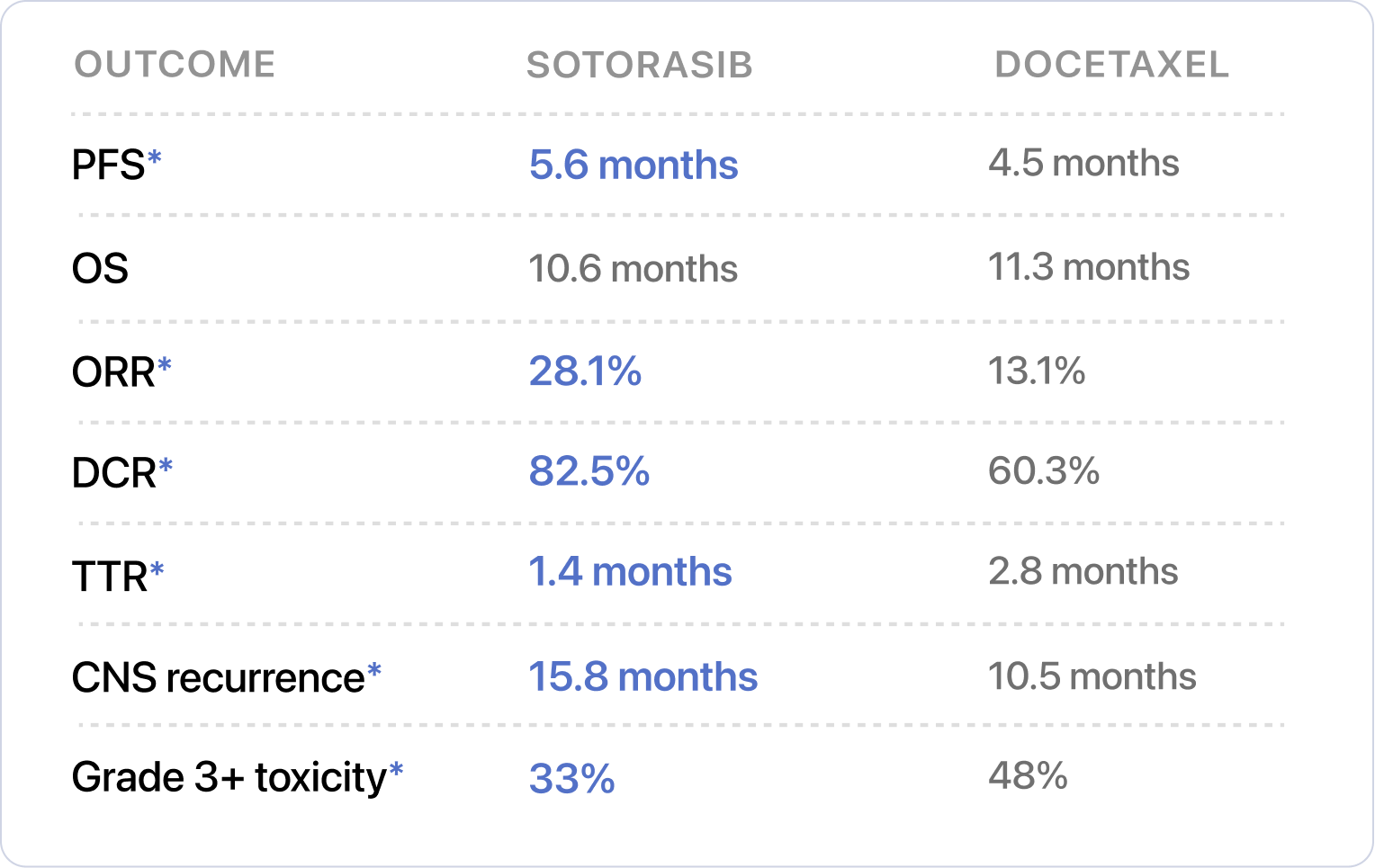
This table lists various study endpoints for the sotorasib versus docetaxel arms. Statistically significant findings are indicated by * (asterisk). |
-
Three hundred forty-six patients (56% of screened total) were ultimately enrolled in the study, with 171 (50%) and 174 (50%), respectively, randomized to sotorasib versus docetaxel.
-
2 (1%) and 23 (13%) patients did not receive sotorasib or docetaxel, respectively, for various reasons, including withdrawal of consent or death. The investigators commented that there was a higher proportion of patients with baseline CNS metastases assigned to the docetaxel arm–though these percentages were comparable overall between treatment arms.
-
23 (13%) of patients continued treatment with sotorasib at data cutoff, while only 7 (4%) continued docetaxel–notably, 46 (26%) of patients crossed over from docetaxel to sotorasib.
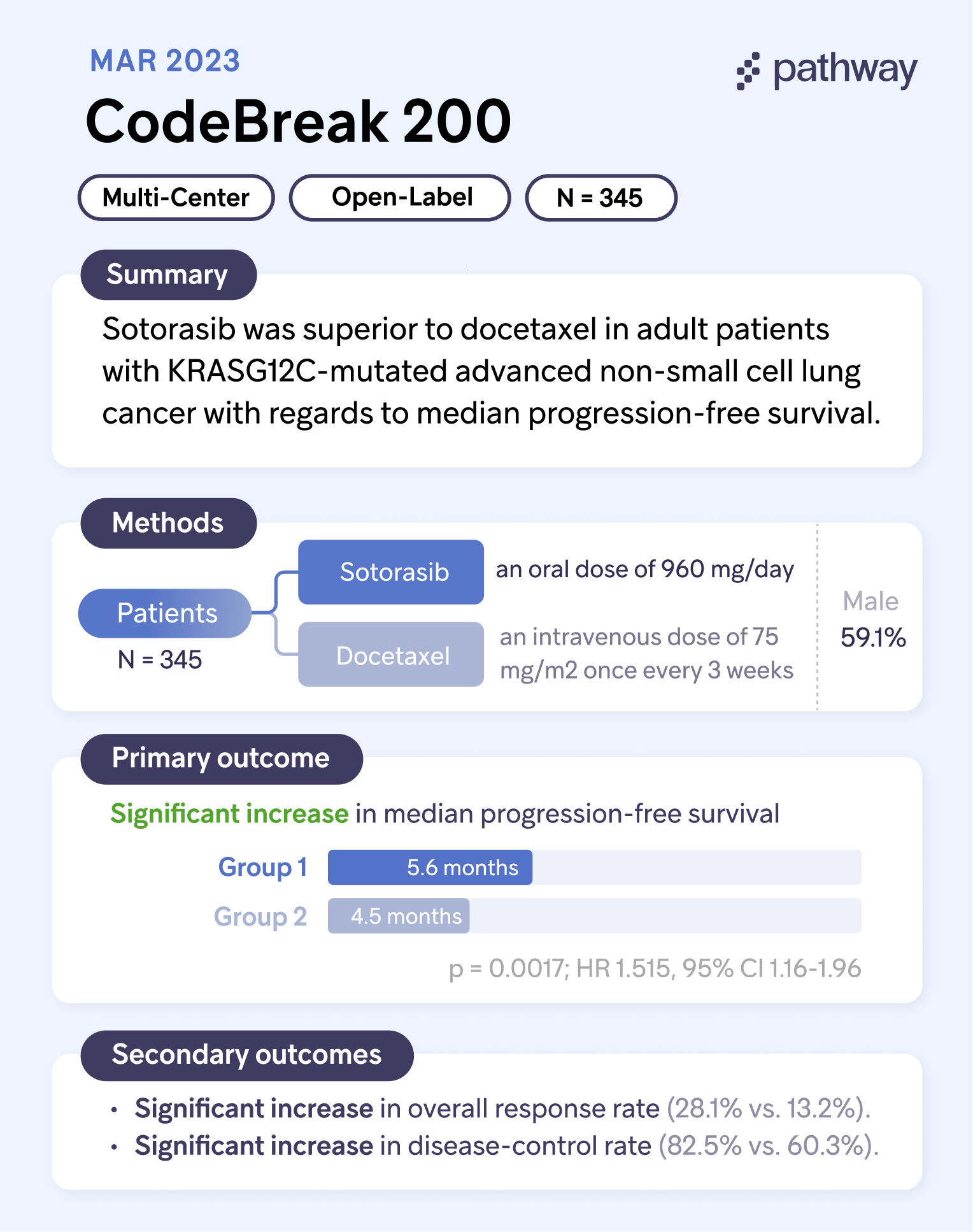
The study met its primary endpoint of statistically significant improvement in mPFS of 5.6 vs. 4.5 months for sotorasib vs. docetaxel with a HR of 0.66 (CI 0.51-0.86; p = 0.0017). 12-month PFS rate was 24.8% vs. 10.1% for both study arms, which was significant for all ad hoc evaluated patient subgroups (e.g., age, ECOG status, CNS metastases, etc.)
The study did not prove an OS benefit with 10.6 vs. 11.3 months for sotorasib vs. docetaxel with a HR of 1.01 (95% CI 0.77-1.33). However, the investigators did find a higher ORR of 28.1% vs. 13.1%, with a difference between arms of 14.8%. Similar improvements were seen in DCR (82.5% vs. 60.3%), time to response (1.4 vs. 2.8 months), and DOR (8.6 vs. 6.8 months). They also note that ORR benefit was seen among all ad hoc evaluated patient subgroups (e.g., age, ECOG status, CNS metastases, etc.). Significantly, however, the median time to recurrence of CNS metastases was delayed 15.8 vs. 10.5 months with a HR of 0.52 in a pre-planned analysis of patients with CNS disease at baseline.
Grade 3 or higher treatment-related adverse events were 33 vs. 48% in the two study arms. The most common trAEs for sotorasib were grade 3+ diarrhea (12%) and ALT/AST increase (9%/8%) – all of which resolved after dose interruption or reduction, though 16 (10%) patients discontinued therapy on trial. For docetaxel, these included neutropenia (12%), fatigue (6%), and febrile neutropenia (5%); 17 (11%) patients discontinued therapy during the trial. There was additionally one fatal case of ILD for sotorasib, and one case each of ileus and multiorgan failure for docetaxel. Important positive PROs included delayed deterioration of global health status, physical functioning, dyspnea, and cough for sotorasib compared to docetaxel.
🔥 Discussion: This is a great pill, but we were hoping to move the needle even more.
-
The investigators demonstrated that sotorasib has meaningful activity in the second-line (or later) settings for patients with metastatic NSCLC with KRAS G12C driver mutations treated with prior lines of platinum-based chemotherapy and immunotherapy.
-
Specifically, the trial met its primary endpoint of improvement in mPFS and various secondary endpoints of overall response rate, disease control rate, time to response, duration of response, treatment-related adverse events, patient-reported outcomes, and health-associated quality of life.
-
Notably, sotorasib, compared to docetaxel, did not improve the secondary endpoints of OS and treatment discontinuation. (Recall the study power alteration due to the sample size reduction mentioned above.)
-
Finally, the pre-planned CNS metastases sub-group demonstrated a significant prolongation of median time to recurrence of CNS disease; in other words, intracranial disease was better controlled.
-
The most common adverse event of sotorasib was hepatotoxicity. Known docetaxel toxicities such as fatigue, cough, and (febrile) neutropenia were significantly mitigated with sotorasib.
❓Limitations
Limitations of the trial include open-label study design, relatively high drop-out rate from the docetaxel standard-of-care arm, over-representation of European patients (74% total patient population), and a possible higher burden of CNS disease in the docetaxel arm. A relative limitation to note is the crossover study design in which patients who progressed on docetaxel were permitted sotorasib therapy while on trial.
📈 Conclusion: Sotorasib – Like It or Not?
This randomized phase 3 trial was less impressive than its phase 2 predecessor (mPFS 5.6 vs. 6.8 months; OS 10.6 vs. 12.5 months; and ORR 28.1 vs. 37.1%). Nevertheless, the study is laudable for paving the way as the first FDA-approved KRAS G12C inhibitor for metastatic NSCLC in the second-line and beyond setting. This drug notably beat current standard-of-care docetaxel +/- ramucirumab or nintedanib regarding PFS, disease control, patient-reported outcomes, and toxicity.
Many patients and providers had hoped for more impressive survival outcomes; however, the disease control and toxicity data – and oral formulation (despite the high pill burden!) – are preferable to several patients who meet treatment criteria. Moreover, patients with known baseline CNS metastases may derive even greater benefit.
|
|
|
What did you think of this newsletter?
Let us know how we did so we can make our next one better for you.
😍 Loved it | 😄 Great | 🙂 Good | 😏 Meh | 👎 Bad
Or hit reply and share any thoughts or requests. We read every reply.
|
|
|
If you enjoyed this newsletter, please consider forwarding it to a friend or colleague who would enjoy it too.
If a friend sent you this, get the next newsletter by signing up here.
Who’s Pathway? We’re a global community of clinicians working to democratize medical knowledge and make practicing evidence-based medicine more accessible, fun, and not so overwhelming.
Warm regards,
- The Pathway Team
You're receiving this newsletter as a free perk for signing up to Pathway.
If you'd rather not receive these emails, you can unsubscribe from all future emails from Pathway by clicking here.
|
|
|
Pathway Medical Inc. | All rights reserved | Unsubscribe |
|
|
|