Answer – (D). Nivolumab and ipilimumab.
Explanation: This patient has stage IIIA MPM that is inoperable due to underlying COPD from tobacco use. The MPM histology is sarcomatoid, a subtype with an otherwise poor prognosis compared to epithelioid MPM. The CHECKMATE-743 study evaluated the combination of nivolumab and ipilimumab versus chemotherapy in patients with unresectable MPM, yielding a 4-month OS advantage compared to platinum-doublet therapy (HR 0.74; 95% CI: 0.60-0.91; P=0.0020). Moreover, subgroup analyses in the sarcomatoid subset demonstrated unprecedented outcomes advantages, thereby rendering this combination therapy as NCCN category 1 guidance in addition to FDA approval.
⌛ Let’s review the incorrect answers:
Choice (A). Pembrolizumab: Pembrolizumab with combination chemotherapy has been evaluated in the IND227 study. It demonstrated that the addition of pembrolizumab to platinum-doublet chemotherapy improved OS by 1.2 months (HR 0.79; 95% CI: 0.64-0.98; P=0.0324), especially in unresectable disease. An exploratory analysis also demonstrated improved findings in the non-epithelioid subset of patients with MPM. While the FDA currently has granted priority review to this therapy, the NCCN guidelines are yet to include it in the “Principles of Systemic Therapy algorithm” as of version 1.2024.
Choice (B). Atezolizumab: The BEAT-MESO study presented at ASCO 2024 as a late-breaking abstract only, demonstrated that adding bevacizumab and atezolizumab to platinum-doublet chemotherapy yielded superior PFS in non-epithelioid histology. While OS findings did not meet pre-specified cutoffs for superiority, exploratory analyses demonstrated an improvement in OS (HR 0.51; 95% CI: 0.32-0.89; P=0.012 for interaction) in the non-epithelioid subtype. The full data from the trial remain to be seen, and there is currently little role for atezolizumab in the treatment of MPM outside of a clinical trial setting.
Choice (C). Nivolumab: As above, the CHECKMATE-743 study solidified the role of dual nivo/ipi in the treatment of unresectable MPM. Previously, the clinical rationale had been built on the Phase 3 CONFIRM trial, which demonstrated that nivolumab led to superior outcomes compared to placebo. Moreover, the Phase 2 MAPS2 trial demonstrated that combination nivo/ipi improved 12-week disease control at the expense of slightly related IO toxicity.
🦠 The patient’s case continues
The patient is started on combination nivolumab 3 mg/kg every 2 weeks IV and ipilimumab 1 mg/kg every 6 weeks IV per the CHECKMATE-743 trial. On cycle 3, he presents with grade 2 diarrhea that resolves with holding one dose of IV ipilimumab alone.
Even though he is aware of the connection between asbestos use and the development of MPM, he is afraid of passing on the illness to his three grown children. He wonders about the role of hereditary germline screening in MPM.
✅ Overview of germline syndromes resulting in MPM
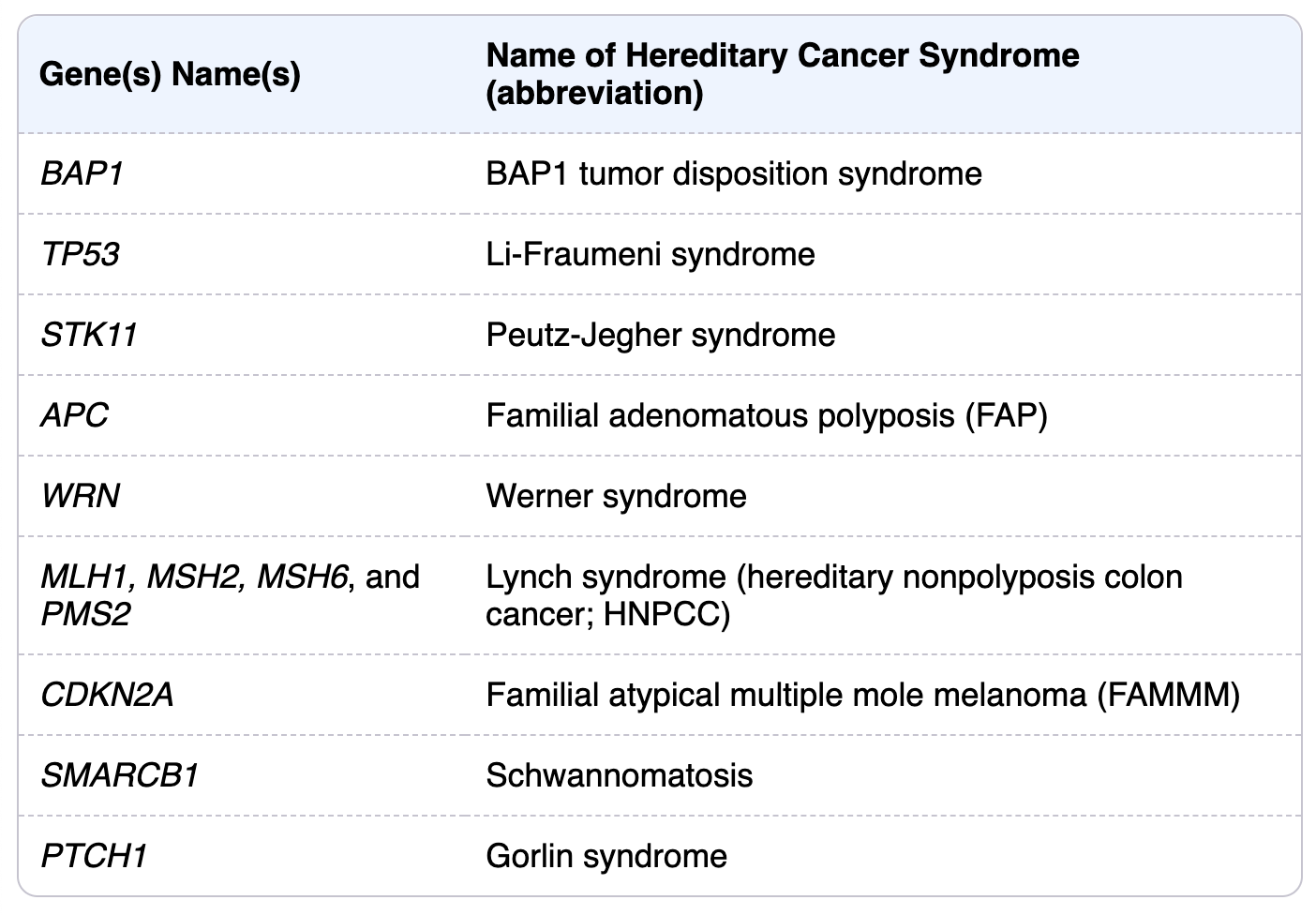
While asbestos exposure is the most common risk factor in the development of MPM, other hereditary germline syndromes account for a minority of cases. Specifically, some other responsible genes and syndromes are listed below: