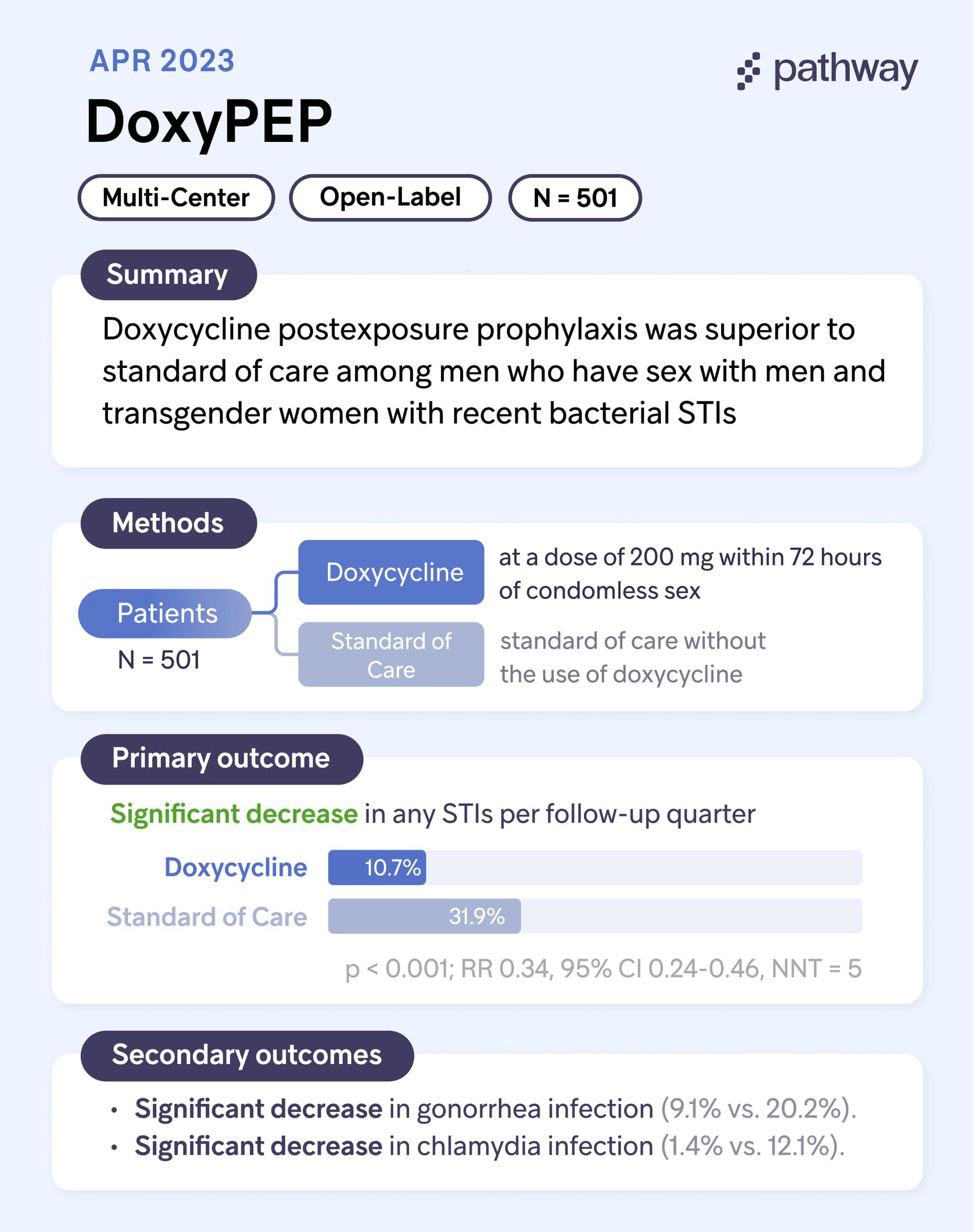
💊 What is the role of doxycycline in post-exposure prophylaxis to prevent STIs?
The DoxyPEP trial (Apr 2023, n=501) compared doxycycline (200 mg within 72 hours of unprotected sex) to placebo in MSM and transgender women with bacterial STIs in the last 12 months. There was a significant decrease in any STI at follow-up (10.7% vs. 31.9%; RR 0.34, 95% CI 0.24 to 0.46, NNT=5).
There was a significant decrease in the secondary outcome of STIs in patients living with HIV (11.8% vs. 30.5%; RR 0.38, 95% CI 0.24 to 0.6). There were borderline significant decreases in both gonorrhea (9.1% vs. 20.2%; RR 0.45, 95% CI 0.32 to 0.65) and chlamydia infections (1.4% vs. 12.1%; RR 0.12, 95% CI 0.05 to 0.25) as well. There was no difference in serious adverse events.
You’ll find more of the latest studies relevant to primary care below. For a more comprehensive catalog of recent practice-changing trials, head over to Pathway!
❤️ What is the role of ezetimibe combination therapy in patients with diabetes and ASCVD?
The RACING trial (Mar 2023, n=1398) compared a moderate-intensity statin plus ezetimibe combination therapy (rosuvastatin 10 mg plus ezetimibe 10 mg per day) to high-intensity statin monotherapy (rosuvastatin 20 mg per day) in patients with diabetes mellitus and ASCVD. There was no significant difference in the primary composite outcome of CV death, major CV events, or non-fatal stroke at 3 years (10% vs. 11.3%; HR 0.89, 95% CI -1.43 to 3.21).
Importantly, there was a significant decrease in intolerance-related discontinuation or dose reduction of the study drug (5.2% vs. 8.7%; ARD -3.5, 95% CI -6.29 to -0.71). There was also a significant increase in patients with a low-density lipoprotein cholesterol level < 70 mg/dL after 1 year and 3 years in the combination group compared to the monotherapy group.
🫁 What is the role of oral fluvoxamine plus inhaled budesonide in high-risk outpatients with early COVID-19?
The TOGETHER trial (Apr 2023, n=1476) compared fluvoxamine (100 mg BID) plus inhaled budesonide (800 µg BID) for 10 days to matching placebos for 10 days in symptomatic adults with COVID-19 with a known risk factor for progression to severe disease. There was a borderline significant decrease in the primary outcome of emergency room visits of > 6 hours or hospitalization for COVID-19 (1.8% vs. 3.7%; RR 0.5, 95% CI 0.25 to 0.92).
There was no significant difference in the secondary outcomes of healthcare follow-up visit of any kind, any emergency room visit, or in death due to COVID-19.
🧠 Is practitioner-supported mindfulness-based cognitive therapy self-help superior to practitioner-supported CBT self-help in adults with depression?
The LIGHTMind trial (Mar 2023, n=410) compared mindfulness-based cognitive therapy self-help (receipt of mindfulness-based cognitive therapy self-help workbook with 6 support sessions from a trained practitioner) to CBT self-help (receipt of CBT self-help workbook with 6 support sessions from a trained practitioner) in adult patients with mild-to-moderate depression. There was a significant decrease in Patient Health Questionnaire-9 (PHQ-9) scores at 16 weeks post-randomization (7.2 vs. 8.6; AD -1.5; 95% CI -2.6 to -0.4).
There was also a significant decrease in Generalized Anxiety Disorder Assessment (GAD-7) item scale score at 16 weeks (5.9 vs. 7; AD -0.95, 95% CI -1.88 to -0.01). There was no significant difference in the short Warwick-Edinburgh mental well-being scale or in work and social adjustment scale scores at 16 weeks.
🖐️ What is the role of colchicine in adults with symptomatic hand osteoarthritis?
The COLOR trial (April 2023, n=100) compared colchicine at a dose of 0.5 mg BID for 12 weeks to a matching placebo in adult patients with symptomatic hand osteoarthritis and finger pain of at least 40 mm on a 100 mm visual analog pain scale. There was no significant difference in the primary outcome of reduction of finger pain at week 12 (13.9 mm vs. 13.5 mm; AD 0.4 mm, 95% CI -6.7 to 7.6). There was no significant difference in adverse or serious adverse events between groups.
🩸 What is the effect of thromboprophylaxis in patients discharged after COVID-19 hospitalization?
The ACTIV-4C trial (Mar 2023, n=1217) compared apixaban at a dose of 2.5 mg BID for 30 days to a matching placebo BID for 30 days in adult patients hospitalized with COVID-19 for > 48 hours and ready for discharge. There was no significant difference in the primary composite outcome of death, arterial thromboembolism, or venous thromboembolism at day 30 (2.13% vs. 2.31%; RR 0.92, 95% CI 0.44 to 1.95).
There was also no significant difference in death from all causes (1.31% vs. 1.48%; RR 0.88, 95% CI 0.34 to 2.28). There was no significant difference in serious adverse events or major bleeding events between groups.
🦠 What is the effect of a 4-antigen S. aureus vaccine in patients undergoing elective spinal fusion procedures?
The STRIVE trial (May 2023, n=3450) compared a 4-antigen S. aureus vaccine to a placebo injection 10 to 60 days prior to surgery in adult patients scheduled for elective spinal fusion surgery. There was no significant difference in the primary outcome of S. aureus bloodstream infections at 90 days post-op (0.5% vs. 0.7%; AD -0.2%, 95% CI -0.4 to 0).
There was also no significant difference in surgical site infections caused by S. aureus (1.6% vs. 1.4%; AD 0.2%, 95% CI -0.37 to 0.77). There was no significant difference in adverse events or systemic events between groups.