📘 Journal Club: Fresh Off the Press |
✅ Study of the Month: New therapy for eczema? |
🪨 What is the role of roflumilast cream in patients with atopic dermatitis? -
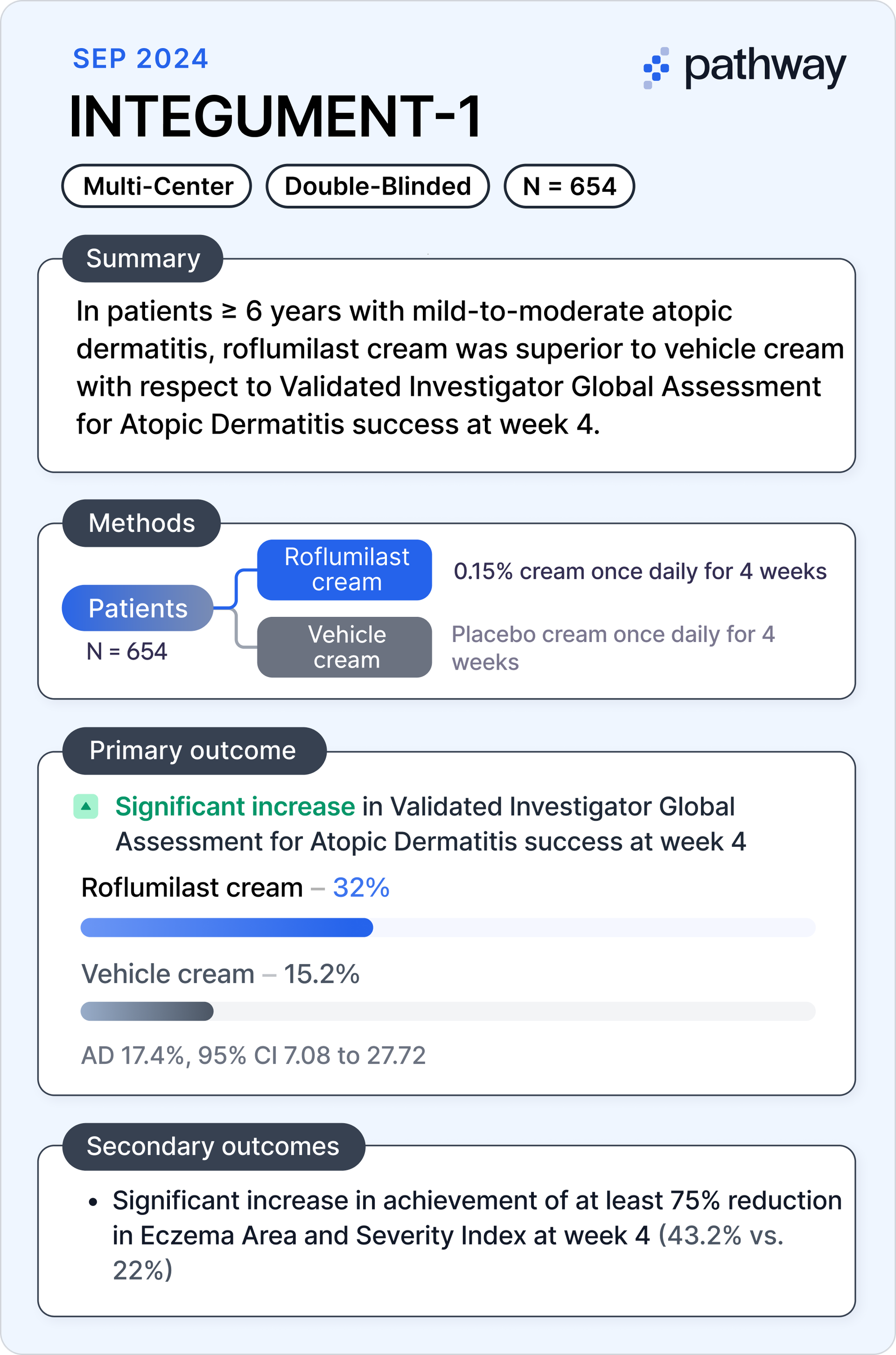
The INTEGUMENT-1 trial (September 2024, n=654) compared roflumilast cream (0.15% cream once daily for 4 weeks) to a matching placebo in patients aged ≥ 6 years with mild-to-moderate atopic dermatitis. The key exclusion criteria included inability to discontinue treatment with therapies for atopic dermatitis before the baseline visit and during the trial, planned excessive exposure of the treated area to natural or artificial sunlight, tanning bed, or another light emitting device, previous treatment with roflumilast cream or foam, or treatment with oral roflumilast in the past 4 weeks.
-
There was a significant increase in Validated Investigator Global Assessment for Atopic Dermatitis success at week 4 (32% vs. 15.2%; AD 17.4%, 95% CI 7.08 to 27.72, NNT=5). One of the secondary outcomes showed a significant increase in achievement of at least a 75% reduction in the Eczema Area and Severity Index at week 4 (43.2% vs. 22%; AD 21.2%, 95% CI 8.62 to 33.78).
Conclusion: In patients aged ≥ 6 years old with mild-to-moderate atopic dermatitis, roflumilast cream was superior to vehicle cream with respect to Validated Investigator Global Assessment for Atopic Dermatitis success at week 4. You’ll find more of the latest studies relevant to primary care below. For a more comprehensive catalog of recent practice-changing trials, head over to Pathway! 🤕 What is the effect of erenumab for non-opioid medication overuse headache in patients with chronic migraine? -
The Erenumab for Medication Overuse Headache trial (September 2024, n=389) compared erenumab (at a SC dose of 140 mg monthly for 24 weeks) to a matching placebo in adult patients with chronic migraine and non-opioid medication overuse headache who had ≥ 1 preventive treatment failures. The key exclusion criteria included age < 18 years, age > 50 years at migraine onset or > 65 years at chronic migraine onset, history of hemiplegic migraine, cluster headache, or other trigeminal autonomic cephalalgia, among others.
-
There was a significant increase in medication overuse headache remission at 6 months (69.1% vs. 52.6%; OR 2.01, 95% CI 1.33 to 3.05, NNT=6). One of the secondary outcomes saw a significantly greater reduction in the least mean square of monthly acute headache medication days over 4-6 months (9.4 days vs. 6.6 days; MD 2.7, 95% CI 1.6 to 3.9).
Conclusion: In adult patients with chronic migraine and non-opioid medication overuse headache who had ≥ 1 preventive treatment failure, erenumab was superior to placebo with respect to medication overuse headache remission at 6 months. 🫘 What is the role of spironolactone in patients with stage 3b CKD? -
The BARACK-D trial (September 2024, n=1372) compared spironolactone (at a dose of 25 mg once daily plus usual care) to usual care in adult patients with stage 3b CKD. The key exclusion criteria included long-standing persistent AF, prior left atrium ablation, other arrhythmias requiring ablative therapy, left atrium ≥ 5.5 cm, or ejection fraction < 35%.
-
There was no significant difference in the first occurrence of death, hospitalization for heart disease, stroke, HF, TIA, or peripheral arterial disease, or first onset of any condition listed not present at baseline at 3-year follow-up (16.7% vs. 16%; HR 1.05, 95% CI 0.81 to 1.37). There was a significant decrease in eGFR at 3 years (41.7 mL/min/1.73m² vs. 42 mL/min/1.73m²; TE -1.14, 95% CI -1.92 to -0.37).
Conclusion: In adult patients with stage 3b CKD, spironolactone was not superior to usual care with respect to first occurrence of death, hospitalization for heart disease, stroke, HF, TIA or peripheral arterial disease, or first onset of any condition listed not present at baseline at 3-year follow-up.
|
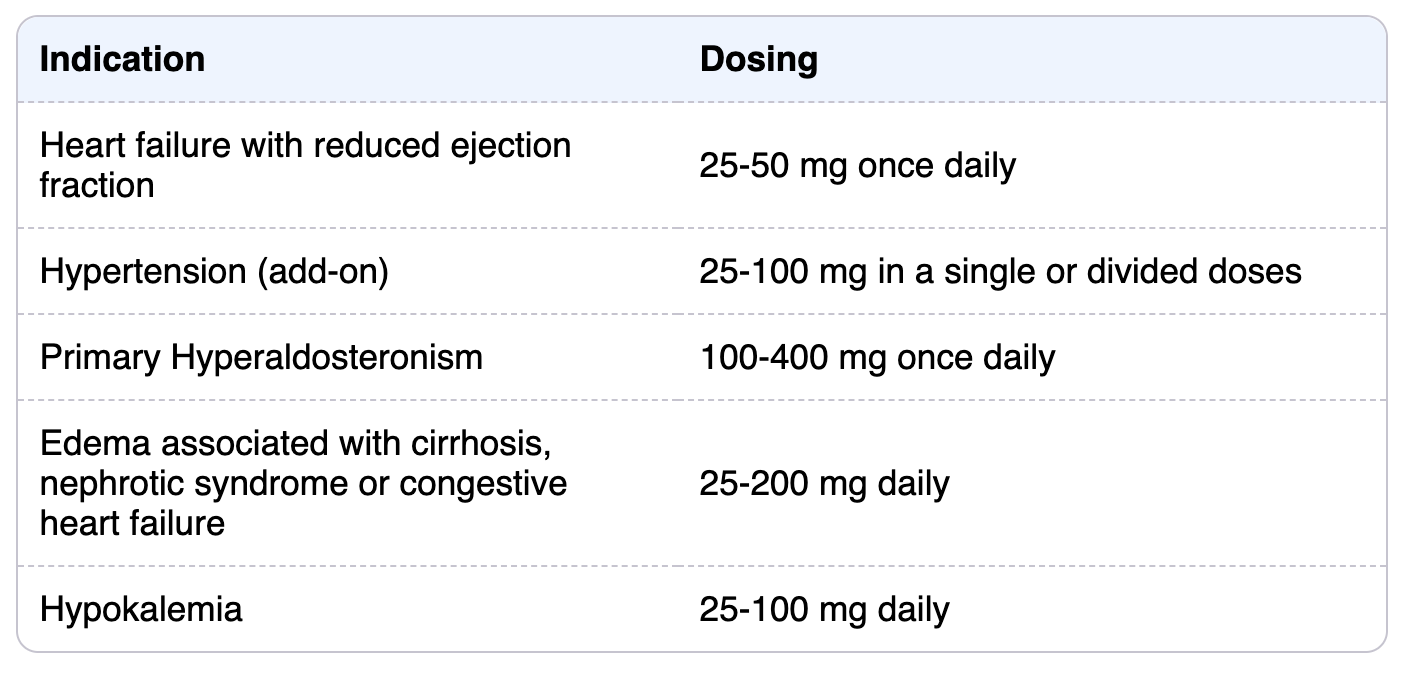
Spironolactone indications and dosing Acknowledgements:
Editorial Team: Jeremy Swisher, MD, Cole Phillips, MD, Khudhur Moh, MD, Hovhannes Karapetyan, MD |
|
|