👃 ‘Tis the (Allergy) Season
✅ Review workup and management of a common condition
📚 Key guideline review for the primary care provider
🧵 And more!
|
|
|
🧠 Test your Knowledge: ‘Tis the (Allergy) Season |
Keep sharpening your clinical skills |
|
|
A 24-year-old male presents to your clinic with a bothersome runny nose, sneezing, and itchy eyes for the last 2 weeks. He has no fever, discolored mucus discharge, or facial pain. He works outside and it is springtime. Which of the following is a preferred initial treatment for this patient?
[A] Diphenhydramine 25mg daily
[B] IM Methylprednisolone
[C] Montelukast
[D] Intranasal fluticasone
Scroll down to find the answer at the end! 👇
Need to refresh your memory before answering this question? Head over to Pathway to review the latest guidelines on allergic rhinitis, acute bacterial rhinosinusitis, and acute viral rhinosinusitis, as well as some landmark trials.
|
|
|
Keep your clinical skills sharp |
Answer - D. Intranasal fluticasone
Explanation - This patient is presenting with classic symptoms of allergic rhinitis (AR). AR is an IgE-mediated inflammatory response of the nasal mucosa after exposure to inhaled allergens, like pollen, pet dander, mold, or other allergens. Seasonal AR is one of the most common variants and the condition presented in this case. Symptoms include an itchy nose, nasal congestion, watery and itchy eyes, postnasal drip, and decreased sense of smell.
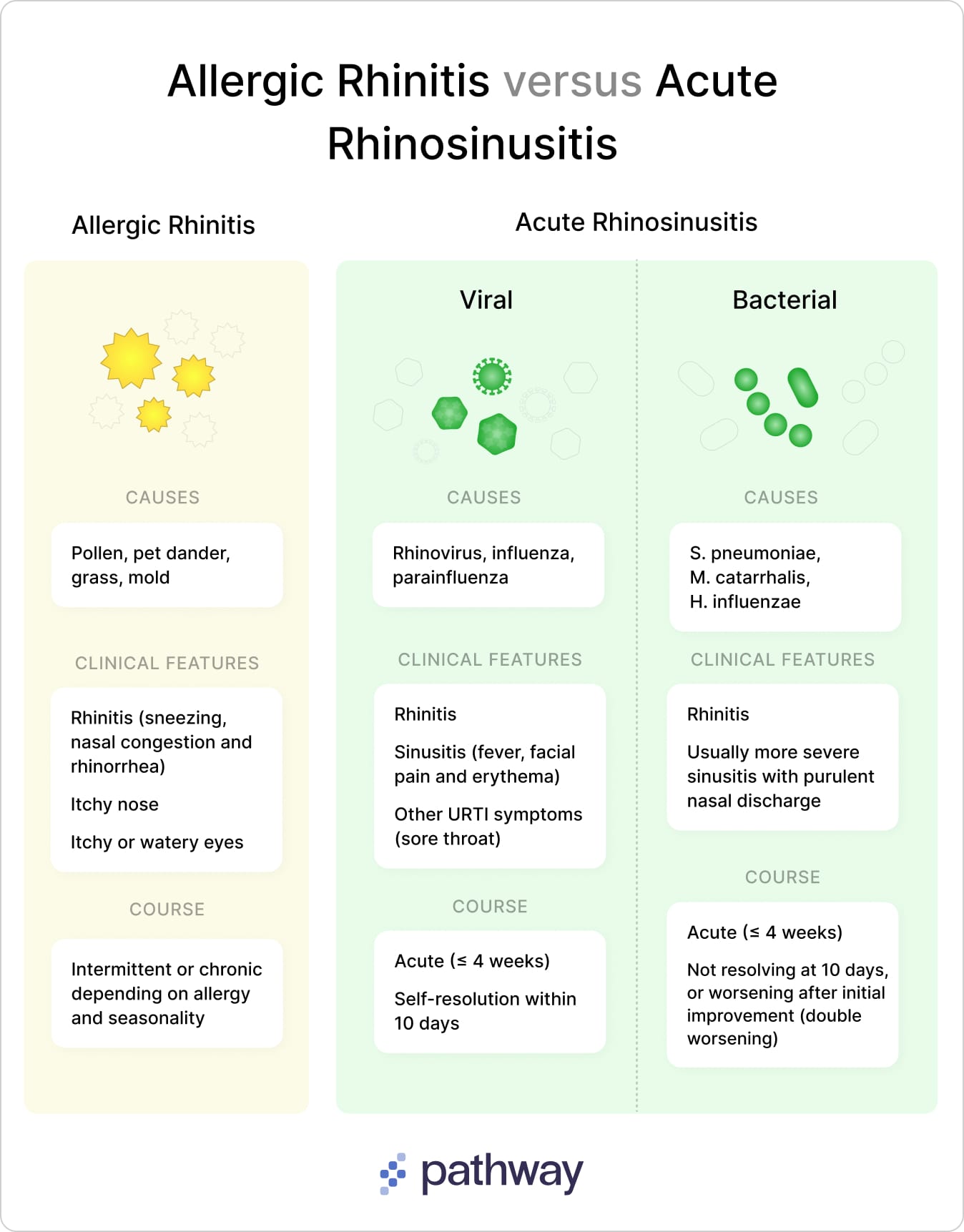
What separates AR from acute rhinosinusitis clinically?
- It can often be difficult to differentiate between AR and acute rhinosinusitis. We made a simple table to keep them straight.
|
What workup should be performed for patients with suspected AR?
-
Patients with allergic rhinitis should be assessed for associated conditions such as asthma, atopic dermatitis, sleep-disordered breathing, conjunctivitis, and otitis media. (B)
-
Obtain specific IgE allergy testing in patients in whom there is uncertainty regarding the diagnosis of allergic rhinitis OR if the knowledge of a specific causative allergen is needed to target therapy OR if there is a lack of initial response to empiric treatment for allergic rhinitis. (B)
- Avoid routine sinonasal imaging in patients presenting with symptoms consistent with a diagnosis of allergic rhinitis. (D)
What is the first-line treatment for AR?
-
Intranasal therapy is the first-line treatment for allergic rhinitis. Choosing intranasal corticosteroids and/or intranasal antihistamines depends on the patient and circumstances.
-
For patients with persistent allergic rhinitis, intranasal corticosteroids should be preferred as monotherapy. (A)
-
For patients with seasonal allergic rhinitis, intranasal antihistamines should be offered as the initial treatment. (A)
-
In practice, often both treatments can be used and are recommended together especially if symptoms are moderate or severe. (B) Intranasal corticosteroids should be used every day to achieve results while intranasal antihistamines can be used on an as-needed basis.
What are other treatment options for AR?
- Administer oral second-generation/less sedating antihistamines for patients with primary complaints of sneezing and itching. (B)
- Offer montelukast in patients with allergic rhinitis only if not treated effectively with or unable to tolerate other alternative therapies. (B)
-
Avoid adding montelukast to intranasal corticosteroids in patients with allergic rhinitis. (D)
- Consider offering intranasal decongestants for short-term and for intermittent or episodic therapy of nasal congestion. (C)
-
Do not use a combination of oral antihistamines and intranasal corticosteroids in preference to monotherapy with an intranasal corticosteroid in patients with seasonal allergic rhinitis and perennial allergic rhinitis. (D)
-
Refer patients who do not respond adequately to pharmacologic therapy to a clinician who can offer immunotherapy. (B)
|
|
|
Help improve Pathway, earn $50 💰💙
Heads up! We're making improvements to Pathway, and we're eager to hear your thoughts.
Next week, we're organizing 45-minute feedback sessions, and we'd like to invite you to book a time slot.
We value your time, and as a thank you, we'll send you a $50 gift card (your pick: Amazon, Visa, Apple, Doordash, and more) or make an equivalent donation in your name.
We look forward to hearing from you!
|
|
|
If you enjoyed this newsletter, please consider forwarding it to a friend or colleague who would enjoy it too.
If a friend sent you this, get the next newsletter by signing up here.
Who’s Pathway? We’re a global community of clinicians working to democratize medical knowledge and make practicing evidence-based medicine more accessible, fun, and not so overwhelming.
Warm regards,
- The Pathway Team
|
|
|
Pathway Medical Inc. | All rights reserved | Unsubscribe |
|
|
|