🧠 Test your Knowledge: Summer Scales
Keep sharpening your clinical skills
|
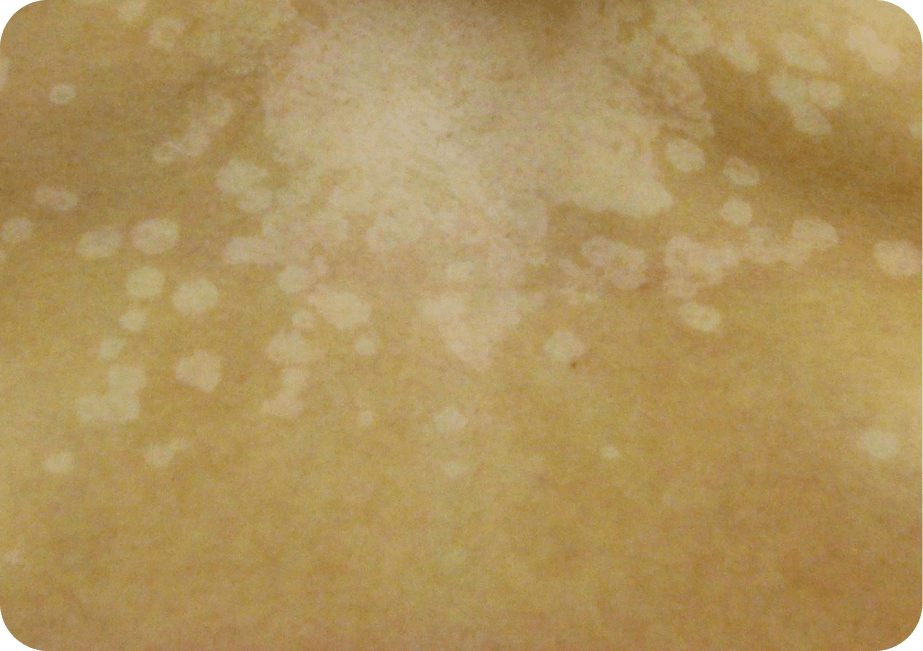
A 27-year-old man presents with multiple well-defined, hypopigmented, scaly macules on his back and upper arms. The lesions are asymptomatic and have been slowly spreading over the past several months. On examination, there is no inflammation or erythema associated with the lesions. The patient is otherwise healthy and denies any systemic symptoms. What is the most appropriate first-line treatment for this condition?
[A] Oral terbinafine
[B] Ketoconzaole 2% shampoo
[C] Triamcinolone ointment
[D] Clobetasol cream
Scroll down to find the answer at the end! 👇
Need to refresh your memory before answering this question? Head over to Pathway to review the latest guidelines on Tinea Versicolor, as well as some landmark trials.
The following summarized guidelines for the evaluation and management of tinea versicolor are prepared by our editorial team based on guidelines from the Japanese Dermatological Association (JDA 2020) and the Danish Society of Dermatology (DSD 2015).
|
Case Conclusion
Keep your clinical skills sharp
Answer - B. Ketoconazole 2% shampoo
Explanation - This patient's clinical presentation is consistent with Tinea Versicolor, a superficial fungal infection caused by Malassezia species. The asymptomatic, well-defined, hypopigmented, and scaly macules without inflammation or erythema align with the characteristic features of Tinea Versicolor.
Ketoconazole 2% shampoo is the most appropriate first-line treatment for Tinea Versicolor, as it targets the causative organism, Malassezia, and helps eliminate the infection. Oral terbinafine is commonly used for systemic fungal infections but is not the first-line treatment for superficial infections like Tinea Versicolor. Corticosteroids may provide relief from inflammation, but it does not address the fungal infection itself.
Tinea Versicolor: [Image Credit]
|
What are the guideline recommendations for topical management of tinea versicolor?
-
Offer topical antifungals as first-line therapy in patients with tinea versicolor. (A)
-
Offer ketoconazole 2% shampoo once daily for 5 days in patients with tinea versicolor. Offer prophylactic treatment once daily for up to 3 days at the beginning of the summer season. (B)
-
Ketoconazole is the most common topical treatment used to treat tinea versicolor. It can also be applied as a cream (twice daily for 15 days) or in a foaming solution (single dose). (E)
-
Consider offering the following regimens in patients with tinea versicolor:
- Selenium sulfide 2.5% shampoo: Once daily for 3 days followed by the same regimen 1 week later. Maintenance therapy once every third month.
- Zinc pyrithione 1% shampoo: 2-3 times weekly
-
Propylene glycol 50% in water: BID for 2 weeks. (C)
What are the guideline recommendations for the medical management of tinea versicolor?
- Offer oral antifungals in selected patients with widespread or recurrent lesions. (A)
-
Systemic therapies include itraconazole (200 mg daily for seven days) and fluconazole (150 to 300 mg weekly dose for 2 to 4 weeks). (E)
-
These are preferred to oral ketoconazole which is no longer approved due to its potential hepatotoxic side effects. (E)
- Oral terbinafine is not effective in the treatment of tinea versicolor. (E)
-
Patients should be informed that the causative agent of tinea versicolor is a commensal fungal inhabitant of the normal skin flora, and therefore the disease is not considered to be contagious. (E)
Expert Opinion on Diagnosis and Evaluation:
-
Diagnosis of tinea versicolor is usually easily made on the basis of its characteristic clinical presentation (hyperpigmented or hypopigmented, finely scaling patches or plaques). (E)
-
The ultraviolet black light (Wood lamp) may help to demonstrate the coppery-orange fluorescence. (E)
-
The diagnosis is confirmed by microscopic examination of scales soaked in potassium hydroxide examination, which demonstrates the typical grape-like clusters of yeast cells and long hyphae. (E)
-
Tinea versicolor skin lesions are usually asymptomatic or slightly pruritic. However, severe pruritus can be present in very warm and humid conditions. (E)
|