Date: Sep 25, 2024 • Issue no: #109
|
🦴 Mystery of Marfan
✅ Review the common diagnostic guidelines 📚 Key pearls for important patient questions
🧵 And more! |
|
|
🧠 Test your Knowledge: Mystery of Marfan |
A 28-year-old male presents to the clinic with complaints of chest pain and shortness of breath. He has a tall, thin body habitus with long extremities and a positive family history of aortic dissection. A chest CT is ordered. Which of the following findings is most likely associated with Marfan syndrome? [A] Aortic root dilation [B] Normal aortic dimensions [C] Ventricular septal defect [D] Pulmonary embolism Scroll down to find the answer at the end! 👇
Need to refresh your memory before answering this question? Head over to Pathway to review the latest guidelines on Marfan Syndrome as well as some landmark trials.
Our editorial team prepared the following summarized guidelines for the evaluation and management of Marfan Syndrome based on guidelines from the European Society of Cardiology (ESC 2024), the Society of Thoracic Surgeons (STS/EACTS 2024), and the American Heart Association (AHA/ACC 2022), among others.
|
|
|
Hear from Healthcare Professionals About ChestPal™ Pro |
ChestPal™ Pro is designed to help you deliver better care. Dr. Emily Tuchman shares that ChestPal™ Pro helps to pick up sounds that are too subtle and can be missed when using a traditional stethoscope. Kevin Shrake, a Registered Respiratory Therapist, emphasizes the importance of reliable and accurate lung sound detection provided by ChestPal™ Pro. And many others have stated that the technology which also enables recording, storing and sharing is a game-changer for patient care.
Enhance the accuracy of your lung sound assessment and patient care with ChestPal™ Pro, the cutting-edge smart stethoscope clinically backed to detect and classify crackles and wheezes.
What Clinicians Are Saying: - Dr Emily Tuchman: “The thing I love about ChestPal Pro is that it helps me to validate my medical decision making.”
-
Kevin Shrake, RT: “Early and accurate detection of lung sounds is crucial. ChestPal™ Pro provides that accuracy, improving patient outcomes.”
Ready to make a difference in your practice? |
|
|
Answer - A. Aortic Root Dilation
Explanation - This patient’s presentation is consistent with Marfan Syndrome, which commonly involves cardiovascular complications such as aortic root dilation. Aortic root dilation is a key finding in Marfan syndrome and represents a weakening of the aortic wall, increasing the risk of aortic dissection or rupture. Early identification of this condition is crucial to prevent life-threatening events.
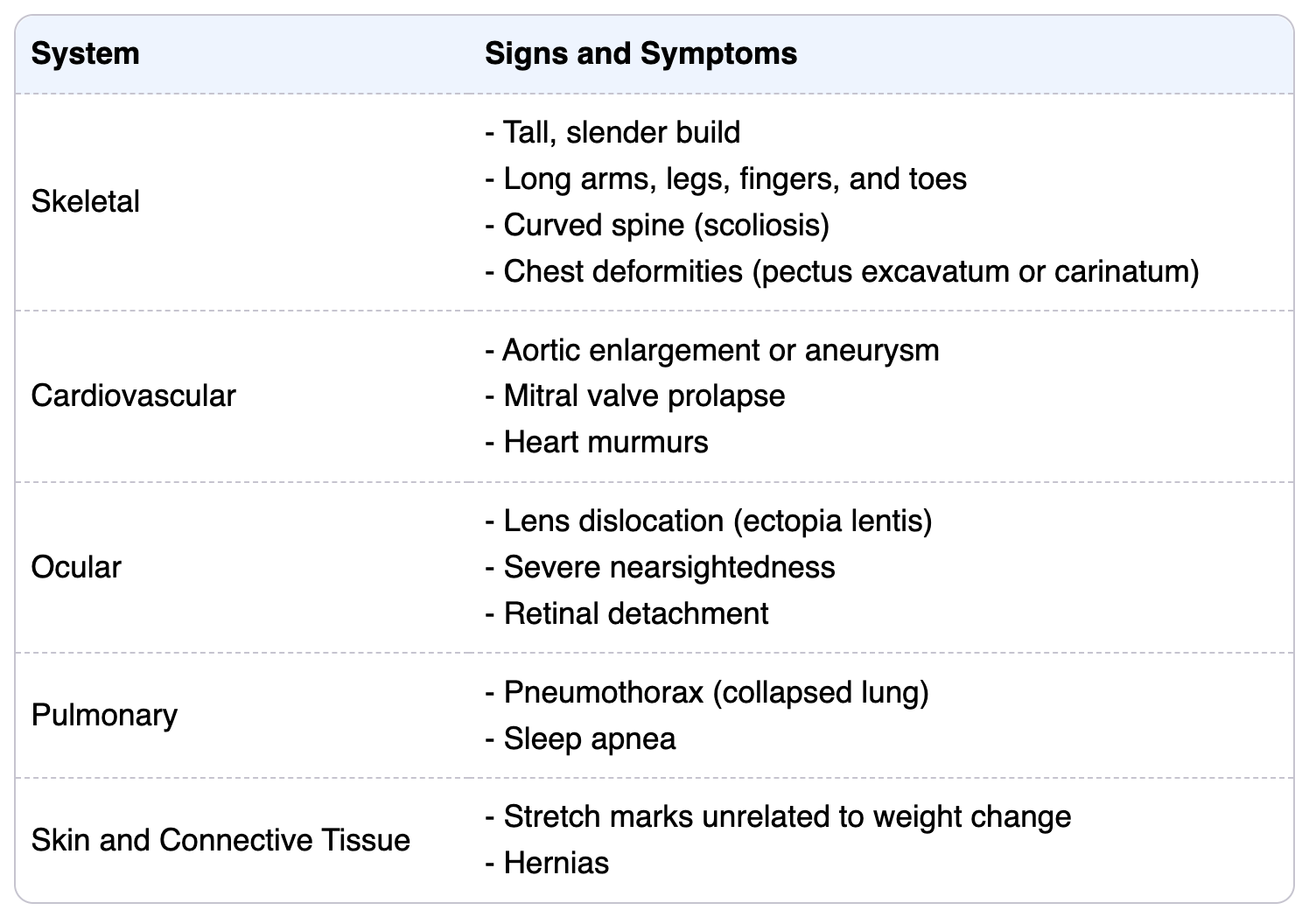
Marfan syndrome also affects the skeletal and ocular systems. Patients often have distinct physical features like a tall, thin frame, long limbs, and hypermobile joints. Eye involvement commonly includes lens dislocation (ectopia lentis) and an increased risk of retinal detachment. Regular monitoring for scoliosis and pectus deformities is also important, as these are common skeletal findings in Marfan patients. Early diagnosis and multidisciplinary care are essential to manage the wide range of complications associated with the condition.
|
|
|
Marfan Syndrome signs and symptoms
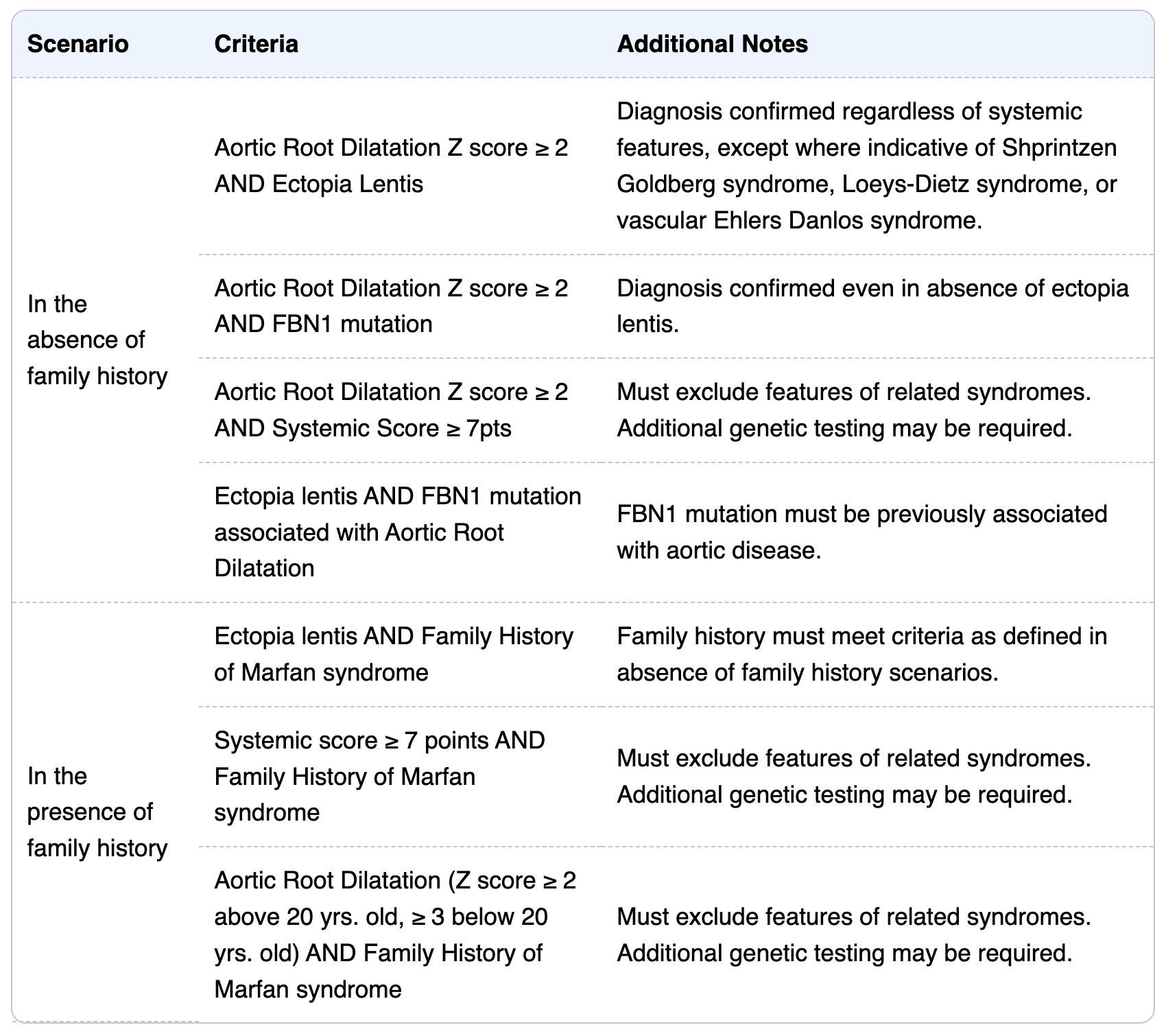
What are the guideline recommendations for the diagnosis of Marfan syndrome? - Obtain TTE in patients with Marfan Syndrome:
- at least annually in patients with an aortic root diameter < 45 mm in the absence of additional risk factors
- at least every 6 months in patients with an aortic root diameter < 45 mm in the presence of additional risk factors
-
at least every 6-12 months in patients with an aortic root diameter ≥ 45 mm in the absence of additional risk factors. (B)
-
Obtain complete peripheral vascular and thoracoabdominal aorta imaging by cardiovascular MRI or cardiovascular CT and duplex ultrasound at the first evaluation and subsequently every 3-5 years, if stable, in patients without previous aortic surgery. (B)
-
Obtain surveillance imaging of the thoracic aorta by cardiovascular MRI or cardiovascular CT at least every 3 years in patients with Marfan Syndrome who have undergone aortic root replacement. (B)
What are the guideline recommendations for the management of Marfan syndrome? -
Initiate either a β-blocker or an ARB in maximally tolerated doses (unless contraindicated) to reduce the rate of aortic dilatation in patients with Marfan Syndrome. (A)
-
Advise individualized physical activity in patients with Marfan Syndrome based on aortic diameter, family history of aortic dissection, and pre-existing fitness. (B)
-
Advise regular moderate aerobic exercise with a level of intensity informed by aortic diameter in most patients with MS. (B)
-
Advise avoiding intense static exercise such as heavy weightlifting or activities requiring the Valsalva maneuver, and collision sports. (B)
-
Perform aortic repair before pregnancy in patients with Marfan's syndrome with an aortic root diameter of ≥ 45 mm. (B)
What are the expert opinion pearls? -
Aortic dissection and rupture are preventable in patients with Marfan Syndrome by replacement of the ascending aorta.
-
Prophylactic surgery is recommended when the ascending aorta's diameter at the aortic sinuses' level reaches 5.0 cm.
-
Patients with an aortic diameter of less than 2.75 cm/m2 are considered to be at low risk of dissection, those with 2.75 to 4.24 cm/m2 are at moderate risk, and those with greater than 4.25 cm/m2 are at high risk. (E)
|
|
|
|
Will you change your practice
behaviors based on the content in
today's newsletter?
|
|
|
|
|
|
|
|
|
|
|
Pathway Medical Inc. | All rights reserved | Unsubscribe |
|
|
|