🧠 Test your Knowledge: Discuss the Discharge
|
A 28-year-old female presents with vulvar itching, burning, and thick, white vaginal discharge. She denies fever, abdominal pain, or foul-smelling discharge. Symptoms have occurred intermittently over the past three months and worsened after completing an antibiotic course for sinusitis. She is sexually active with one partner and uses oral contraceptives. Her last menstrual period was two weeks ago. Physical examination reveals vulvar erythema and thick, curd-like vaginal discharge.
Laboratory results are as follows: - Vaginal pH: 4.0
- Wet mount (saline): Negative for clue cells
- KOH prep: Budding yeast and pseudohyphae observed
- Nucleic acid amplification test (NAAT) for Trichomonas: Negative
Which of the following is the most likely diagnosis? [A] Bacterial vaginosis
[B] Trichomoniasis [C] Recurrent vulvovaginal candidiasis [D] Physiologic leukorrhea
Scroll down to find the answer at the end! 👇
Need to refresh your memory before answering this question? Head over to Pathway to review the latest guidelines on Vulvovaginal candidiasis as well as some landmark trials.
Our editorial team prepared the following summarized guidelines for the evaluation and management of vulvovaginal candidiasis based on guidelines from the Infectious Diseases Society of America (IDSA/CDC/NIH/HIVMA 2024), the World Health Organization (WHO 2024), and the Center for Disease Control (CDC 2021), among others. |
Case Conclusion Answer - C. Recurrent vulvovaginal candidiasis
Explanation - This patient’s presentation is consistent with recurrent vulvovaginal candidiasis, characterized by symptoms of vulvar itching, burning, and thick, white, “curd-like” discharge. The vaginal pH of 4.0 is within the normal range, which helps rule out bacterial vaginosis and trichomoniasis. The observation of budding yeast and pseudohyphae on the KOH prep confirms the presence of Candida species as the causative organism.
Recurrent vulvovaginal candidiasis is defined as four or more episodes in one year. It is often associated with factors such as recent antibiotic use, which disrupts the normal vaginal flora, and hormonal influences, such as those from oral contraceptives. Management includes antifungal treatment and, in recurrent cases, may involve maintenance therapy with oral or topical antifungals. Addressing predisposing factors, such as limiting unnecessary antibiotic use, is also essential.
What are the guideline recommendations for the medical management of vulvovaginal candidiasis? -
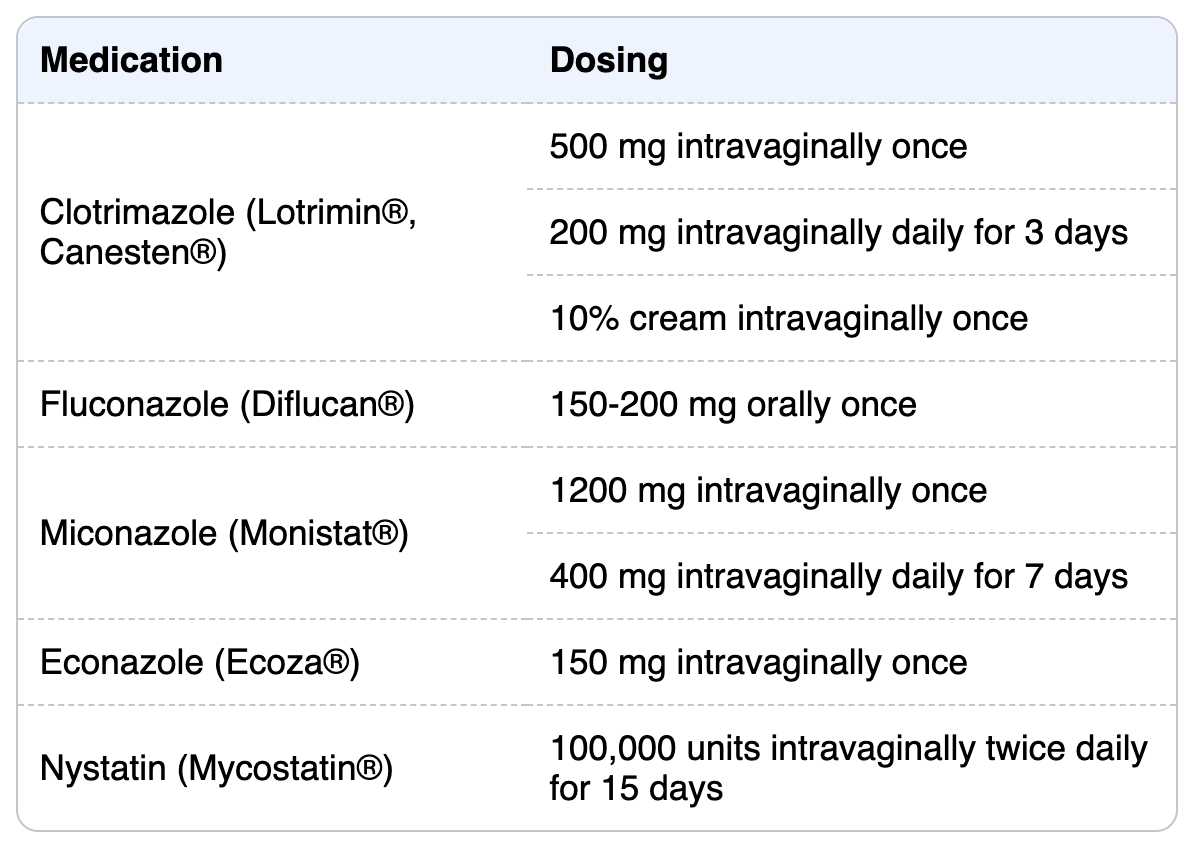
Consider administering the following options in adult and adolescent patients with vulvovaginal candidiasis:
- fluconazole 150-200 mg PO as a single dose
-
clotrimazole 500 mg intravaginally as a single dose, or 200 mg intravaginally once daily for 3 days, or 10% cream intravaginally once
- miconazole 1,200 mg intravaginally as a single dose or 400 mg intravaginally once daily for 7 days
-
econazole 150 mg intravaginally as a single dose
- nystatin 100,000 units intravaginally BID for 15 days. (C)
-
Administer fluconazole 150 mg PO every 72 hours, a total of 2-3 doses, in patients with severe acute vulvovaginal candidiasis. (A)
-
Administer a 3-day induction course of an azole followed by long-term maintenance suppressive regimen for at least 6 months in patients with persistent and recurrent vulvovaginal candidiasis. (B)
-
Prefer topical therapy for the treatment of vulvovaginal candidiasis in pregnancy. (B)
- Consider administering the following option in pregnant patients with vulvovaginal candidiasis:
- clotrimazole 100 mg intravaginally once daily for 7 days or 1% cream intravaginally once daily for 7 days
- nystatin 100,000 units intravaginally BID for 15 days. (C)
|
Vulvovaginal candidiasis treatment options and dosing
Acknowledgements: - Editorial Team: Jeremy Swisher, MD, Cole Phillips, MD, Khudhur Moh, MD, Hovhannes Karapetyan, MD
|
|
|